
Overview
Assumptions
Suitable for K-12 schools, universities, and educational campuses, targeting school administrators, security teams, and educational facility integrators.
Core Value
Solves the problem of campus perimeter security, unauthorized visitor access, and student safety management.
Avoids unauthorized entry, unclear visitor accountability, and inability to respond quickly to security incidents.
Provides controlled campus access, visitor management, and emergency response capability.
Guide Structure
Product Overview
What is this solution?
School access control must protect students while supporting the educational environment. The challenge is managing diverse user types (students, staff, parents, visitors, contractors) with very different access patterns and needs. Emergency lockdown capability is critical, and the system must be operable by non-technical staff during emergencies.
Key Capabilities
Perimeter Access Control
Controlled entry at all campus perimeter points with visitor verification.
Emergency Lockdown
Rapid campus-wide lockdown capability operable by authorized staff.
Visitor Management
Structured visitor check-in with identity verification and escort requirements.
Student & Staff Access
Role-based access for students, teachers, and administrative staff.
Value by Role
Campus security is a duty of care; access control is a core tool.
Clear visitor records and emergency lockdown capability.
Classroom access control that supports teaching without creating barriers.
School projects require emergency lockdown testing and non-technical staff training.
Selection Method
Selection Framework
Use the following decision steps to determine if this solution fits your project. Each step narrows the selection scope and identifies key risk areas.
Emergency lockdown capability must be tested with non-technical staff before deployment.
Visitor management is often the highest-risk area; prioritize it in system design.
Student access should be simple and reliable; avoid complex authentication for routine access.
When budget is limited, focus on perimeter control and visitor management before interior areas.
Quick Decision Rules
If your project has more than 3 sites or 100+ door points, prioritize platform scalability over device cost.
If personnel turnover is high, ensure the permission revocation workflow is automated, not manual.
If the area is high-security (server room, pharmacy), require dual-factor authentication as a minimum.
If integration with HR or attendance systems is required, verify API compatibility before procurement.
Application Scenarios
Applicable Scenarios
K-12 schools with perimeter security needs
University campuses with multiple buildings
Educational facilities with public access areas
Schools with after-hours facility use
Scenario Characteristics
Personnel Structure
Evaluate the complexity of personnel types, turnover rate, and permission granularity requirements.
Security Level
Determine authentication strength requirements based on asset value and regulatory requirements.
Growth Expectation
Consider future expansion, new sites, and system integration requirements in the selection.
Metrics & Acceptance
Key Performance Indicators
| Indicator | Minimum Standard | Enhanced Standard | Verification Method |
|---|---|---|---|
| Authentication Response Time | < 2 seconds | < 0.5 seconds | On-site timing test |
| False Rejection Rate (FRR) | < 1% | < 0.1% | 100-sample test |
| Offline Operation Duration | 4 hours | 72 hours | Power-off simulation |
| Permission Sync Latency | < 5 minutes | Real-time (< 30s) | Add/revoke timing |
| Event Log Retention | 90 days | 365 days+ | Platform query check |
| Emergency Release Time | < 10 seconds | Automatic on alarm | Fire alarm simulation |
Acceptance Checklist
Installation Conditions
All perimeter entry points must be identified and included in the access control plan.
Environment Requirements
Outdoor terminals must be weatherproof and vandal-resistant.
Commissioning Requirements
Emergency lockdown must be tested with actual staff under simulated conditions.
Operations Requirements
Establish clear procedures for visitor management, emergency lockdown, and credential management.
Common Pitfalls
Emergency lockdown procedures are often not practiced; regular drills are essential.
Compare & Recommend
Tier Definition
Entry Tier
Target: Small single-site, low security requirement, limited budget
Risk: Limited scalability, manual management
Professional Tier
Target: Multi-site or medium-scale, compliance requirements, integration needs
Risk: Higher deployment complexity, requires professional integration
Enterprise Tier
Target: Large-scale, high security, multi-system integration, audit requirements
Risk: High investment, long implementation cycle
Recommended Combinations
Basic Combination
Required
- Perimeter entrance terminals
- Emergency lockdown controls
- Visitor management module
- Access management platform
Scenario: Single-site, standard security, < 50 door points
Risk: Difficult to expand later, manual permission management
Professional Combination
Required
- Perimeter entrance terminals
- Emergency lockdown controls
- Visitor management module
- Access management platform
Optional Add-ons
- Classroom door access control
- Student attendance integration
- Video surveillance linkage
Scenario: Multi-site or compliance-required, 50–500 door points
Risk: Integration complexity, requires professional deployment
Enterprise Combination
Required
- Perimeter entrance terminals
- Emergency lockdown controls
- Visitor management module
- Access management platform
Optional Add-ons
- Classroom door access control
- Student attendance integration
- Video surveillance linkage
- Parent notification integration
- Contractor management module
Scenario: Large-scale, high security, full integration, 500+ door points
Risk: High investment, long implementation, requires experienced integrator
Compatibility & Integration
System Overview
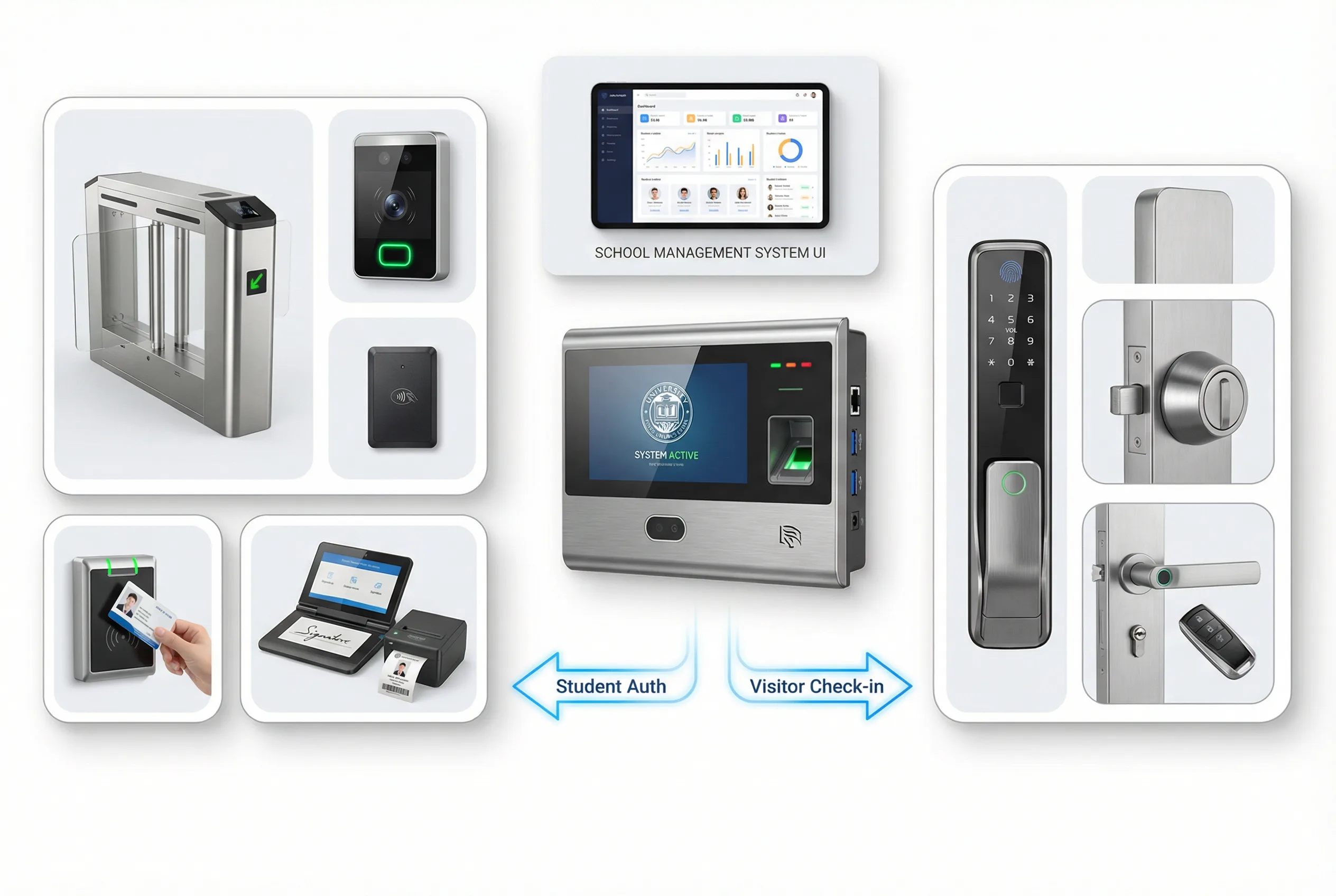
The system consists of perimeter entrance terminals, building entrance terminals, visitor management kiosk, emergency lockdown controls, access management platform, and integration with school information systems.
Integration Objects
HR / Identity Management System
Sync personnel join/leave/transfer events
Video Surveillance (CCTV/VMS)
Link access events with video evidence
Visitor Management System
Automate temporary access credential issuance
Fire Alarm / BMS
Emergency release and evacuation linkage
Attendance System
Avoid duplicate card-swiping infrastructure
Elevator Control System
Extend access control to floor-level
Integration Risks & Mitigation
Protocol mismatch between controller and platform
Consequence: Events not reported, permissions not synced
Mitigation: Verify protocol compatibility before procurement; request test environment access
HR system API changes break permission sync
Consequence: Permission residuals after personnel departure
Mitigation: Use middleware or webhook-based integration; implement daily sync audit
Fire alarm release conflicts with access control logic
Consequence: Doors fail to open during emergency, evacuation blocked
Mitigation: Define fire release priority in system design; test linkage before go-live
Network latency causes offline controller permission lag
Consequence: Revoked credentials still grant access
Mitigation: Set offline permission cache TTL; implement emergency revocation mechanism
Installation & O&M
Installation Process
- 1
Students and staff are enrolled with role-based campus access permissions.
- 2
Visitors check in at the entrance with identity verification and receive temporary badges.
- 3
Access events are recorded for attendance and security purposes.
- 4
Emergency lockdown is activated by authorized staff, securing all campus entry points.
- 5
Post-incident access logs support investigation and reporting.
Pre-installation Risk Checklist
Confirm door frame material and lock mounting compatibility
Verify power supply capacity for all lock and controller loads
Check network connectivity and bandwidth at each door point
Confirm fire alarm integration protocol with fire system vendor
Verify cable routing path is free of interference sources
Confirm backup power (UPS/battery) runtime meets requirements
Validate reader mounting height and angle for user accessibility
Check environmental conditions (temperature, humidity, dust) for outdoor readers
Common Installation Errors
Mixing power and signal cables in the same conduit
Consequence: Electromagnetic interference causing reader malfunction
Correct Approach: Separate conduits for power and signal; maintain 30cm minimum distance
Installing readers in direct sunlight without weatherproofing
Consequence: Accelerated aging, biometric failure in high temperature
Correct Approach: Use IP65+ rated readers; add sun shade for outdoor installations
Not testing emergency release before handover
Consequence: Emergency release fails during real incident
Correct Approach: Mandatory fire alarm linkage test before project acceptance
O&M Monitoring & Maintenance
| Item | Frequency | Action |
|---|---|---|
| Door lock mechanical check | Monthly | Test lock/unlock force, check alignment |
| Controller communication status | Weekly | Check online status in platform dashboard |
| Backup power battery capacity | Quarterly | Simulate power outage, verify runtime |
| Permission audit | Monthly | Review active credentials vs. current personnel list |
| Firmware/software updates | Quarterly | Apply security patches; test in staging first |
Ready to Start Your Project?
Contact our solution team for expert access control selection advice and quotation.